

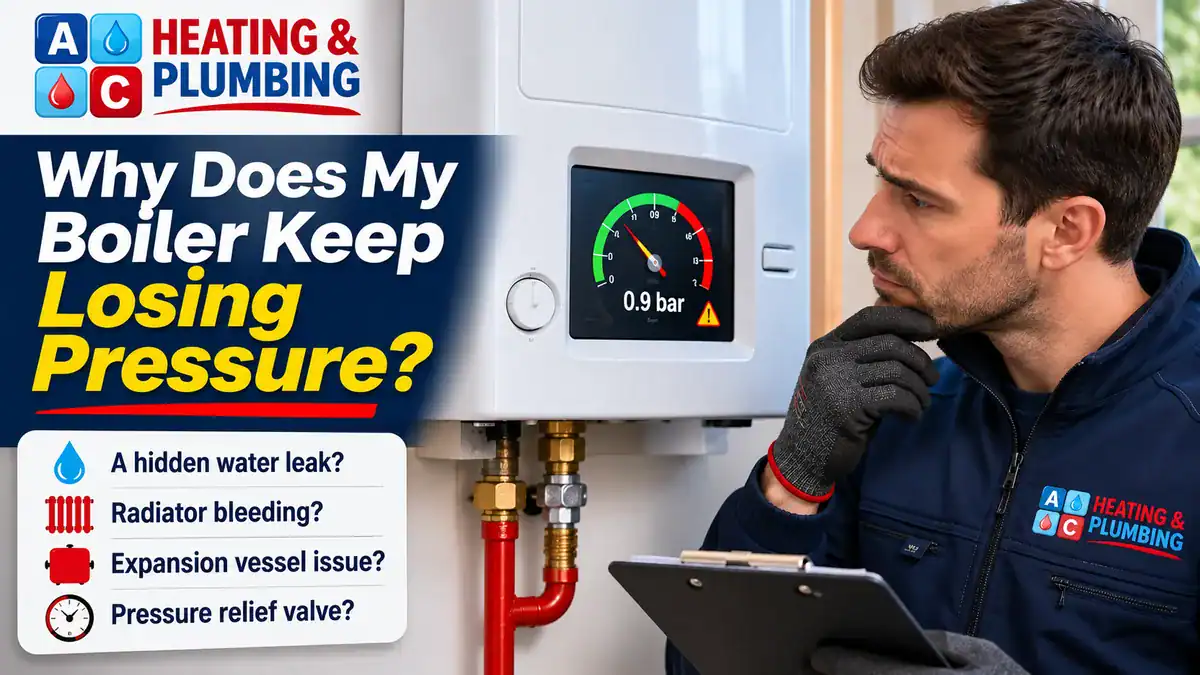
Your boiler pressure gauge was at 1.5 bar last week and now it is close to zero – again. You top it up, the heating comes back on, and a few days later the pressure has dropped once more. A boiler that keeps losing pressure is one of the most common winter problems we see across North & West London, and it almost always has a clear cause.
The short answer: water is escaping from the system somewhere – through a leak, a pressure relief valve that keeps opening, or a faulty part inside the boiler. Topping up fixes the symptom, not the cause. If it keeps happening, our Gas Safe engineers can trace the fault as part of a boiler repair visit, usually in a single call-out.
📏 What Should My Boiler Pressure Be?
Most combi and system boilers should read between 1 and 1.5 bar when the heating is off and cold. When the heating is running, it is normal for the needle to rise a little, typically to around 2 bar. Always check the manual for your model, as recommended levels vary slightly between manufacturers.
- Below about 0.5–1 bar: many boilers lock out and show a low-pressure fault code. No heating, no hot water.
- Between 1 and 2 bar: normal working range.
- Close to 3 bar: too high – the pressure relief valve will open to protect the system, and water is lost.
🔍 6 Common Reasons Your Boiler Keeps Losing Pressure
1. A small leak in the heating system
The most common cause. Look for drips or damp patches around radiator valves, towel rails, visible pipework and the bottom of the boiler. Even a slow drip from a valve gland can lose enough water to drop the pressure over a few days. Leaks under floors or behind walls are harder to spot – signs include stained ceilings, warped floorboards or a damp smell. If water is coming from the boiler itself, read why a leaking boiler should never be ignored.
2. The pressure relief valve (PRV) is letting water out
The PRV is a safety valve that opens when pressure gets too high. It usually connects to a short copper pipe that goes outside through the wall. If that pipe is dripping, or there are water marks on the wall below it, the valve is opening – either because the system pressure is too high, or because the valve itself is worn and no longer seals.
3. A faulty expansion vessel
Water expands when it heats up. The expansion vessel inside the boiler absorbs that extra volume. When the vessel loses its air charge, the pressure climbs quickly every time the heating comes on, the PRV opens, and the pressure is low again when the system cools. A typical sign: the needle jumps above 2.5 bar when the heating runs and drops well below 1 bar when it is off. Re-charging or replacing the vessel is a job for a Gas Safe engineer.
4. You have recently bled the radiators
Bleeding radiators lets out trapped air – and the pressure drops as a result. That is normal. Top the pressure back up once afterwards; if it then stays stable, there is no fault.
5. A leak inside the boiler
Worn seals, a corroded heat exchanger or a failing pump seal can leak inside the casing, where you cannot see it. Never remove the boiler cover yourself – only a Gas Safe registered engineer may work on the inside of a gas boiler.
6. A faulty filling loop or auto air vent
A filling loop that does not close fully, or an automatic air vent that sticks open, can also cause pressure to drift. These are small, inexpensive parts, but they need to be diagnosed correctly.
🛠️ What You Can Check Safely Yourself
- Write down the pressure when the boiler is cold, and again a day later. Knowing how fast it drops helps the engineer find the cause.
- Look for visible leaks around radiators, valves, exposed pipes and under the boiler.
- Check the copper pipe outside (the PRV discharge pipe) for drips or water stains.
- Top up the pressure using the filling loop, following your boiler manual, until the gauge reads around 1–1.5 bar with the heating off. Then reset the boiler – our guide on how to reset your boiler safely walks you through it.
- Watch the gauge while the heating runs. A jump above 2.5 bar points to the expansion vessel or the PRV.
⚠️ Do not open the boiler casing, adjust gas parts or keep overfilling the system. If you smell gas, leave the property and call the National Gas Emergency number on 0800 111 999.
📞 When to Call a Gas Safe Engineer
- You have to top up the pressure more than once a week.
- Water is dripping from the boiler, the PRV pipe or anywhere in the system.
- The pressure rises close to 3 bar when the heating is on.
- The boiler keeps locking out with a low-pressure fault code.
- There is no heating or hot water in cold weather – book emergency boiler repair, especially with children or elderly people in the home.
If your boiler keeps losing pressure, an engineer will pressure-test the system, check the expansion vessel charge, the PRV and the internal components, and tell you clearly what needs fixing before any work starts. You can see how we price repairs on our boiler repair costs page. Problems like a flat expansion vessel are often picked up early during an annual boiler service.
❓ Frequently Asked Questions
Is it dangerous if my boiler loses pressure?
Low pressure itself is not dangerous – modern boilers simply shut down to protect themselves. The risk is the cause: a hidden leak can damage floors and ceilings, and a constantly opening relief valve should always be checked.
Can I just keep topping up the pressure?
Occasionally, yes – for example after bleeding radiators. But if you need to do it regularly, you are adding fresh, oxygen-rich water each time, which speeds up corrosion and sludge inside the system. Find and fix the cause instead.
Why does my boiler pressure go up when the heating is on and down when it is off?
A small rise is normal. A big swing – from under 1 bar to over 2.5 bar – usually means the expansion vessel has lost its charge and needs re-pressurising or replacing.
How long does it take to fix a boiler that keeps losing pressure?
Many causes, such as a worn PRV, a faulty filling loop or a flat expansion vessel, can be fixed in a single visit. Hidden leaks under floors can take longer to trace, and we will explain the options before starting.
Need a hand with this? Our Gas Safe registered engineers cover North & West London, with 24/7 emergency call-outs. Find out more about our boiler repair service.
⭐ 4.9/5 from 60 Google reviews · Gas Safe registered engineers · 15+ years’ experience