

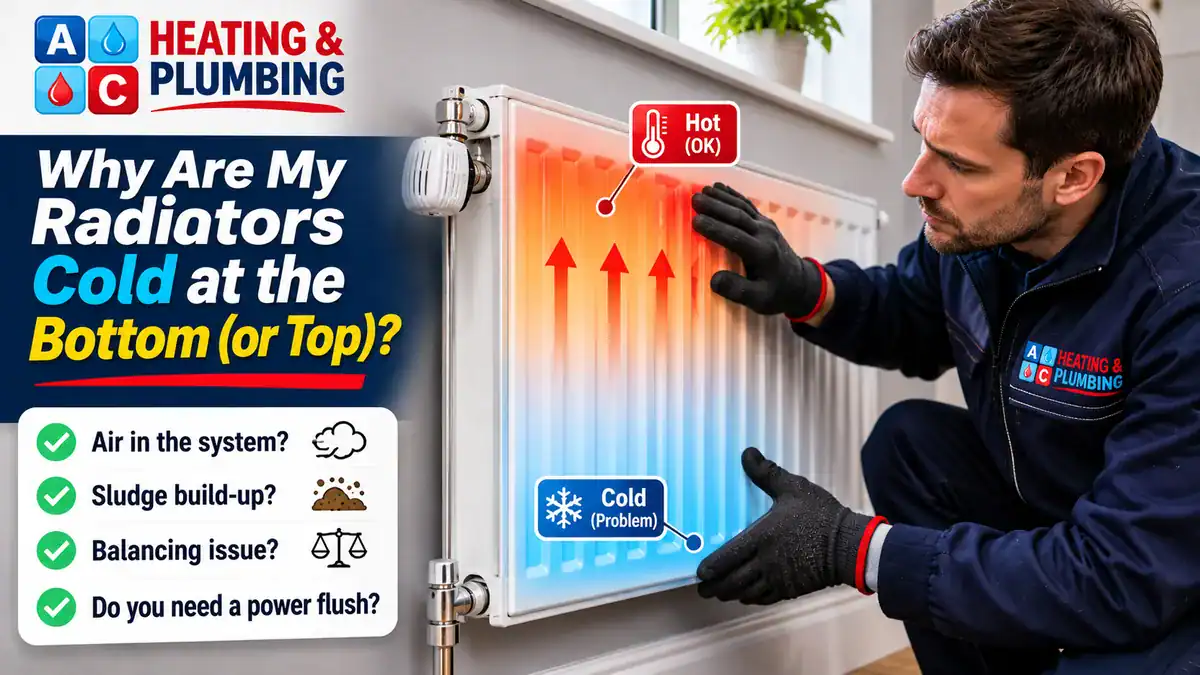
Are your radiators cold at the bottom but warm at the top – or the other way round? Maybe one radiator stays cold while the rest of the house is warm. Each pattern points to a different cause – and knowing which one you have saves time and money.
The short answer: a radiator that is cold at the bottom is almost always full of sludge – rust and debris that settle in the lowest part of the panel and block the flow of hot water. Bleeding will not fix it; the system needs cleaning, usually with a power flush. A radiator that is cold at the top usually just has trapped air, which you can often release yourself.
🌡️ What the Cold Spot Tells You
- Cold at the bottom, warm at the top: sludge (black iron oxide, also called magnetite) has built up inside the radiator.
- Cold at the top, warm at the bottom: air has collected at the top of the radiator.
- Cold in the middle: usually sludge, often in older radiators.
- One radiator completely cold: a valve is closed or stuck, or the radiator is blocked.
- Radiators furthest from the boiler are cooler: the system needs balancing, or the pump is struggling.
- All radiators cold: the problem is the boiler, the pump or the system pressure, not the radiators.
🟤 Radiators Cold at the Bottom: Sludge Build-Up
Over the years, water inside a central heating system reacts with the steel of radiators and pipes. The result is a black, muddy sludge that sinks to the bottom of each radiator. As it builds up, hot water can no longer reach the lower part of the panel, so you get a warm top and a cold bottom.
Other signs that sludge is the cause:
- Several radiators have cold patches at the bottom, not just one.
- Water released when you bleed a radiator is dark or black.
- The boiler is noisy or the heating takes longer to warm the house.
- You often need to bleed the radiators, or the pump has been replaced recently.
Sludge does not go away on its own. A power flush pumps water and cleaning chemicals through the whole system at high flow to lift the sludge out, then refills it with clean water and inhibitor. Fitting a magnetic filter afterwards helps stop it coming back. If you are not sure, our checklist of the 7 signs your central heating needs a power flush will help you decide.
💨 Radiators Cold at the Top: Trapped Air
Air collects at the highest point of the radiator and stops hot water filling the top of the panel. Bleeding the radiator lets the air out:
- Turn the heating off and let the radiators cool down.
- Hold a cloth under the bleed valve at the top corner and open it a quarter turn with a radiator key.
- Close it as soon as water starts to come out instead of air.
- Check the boiler pressure gauge – bleeding lowers the pressure, so top it up to around 1–1.5 bar if needed.
If the pressure keeps dropping after you have topped it up once, read why your boiler keeps losing pressure. And if you have to bleed the same radiators every few weeks, something is letting air into the system – a job for an engineer.
❄️ One Radiator Completely Cold
- Check both valves are open. The thermostatic valve (TRV) should be turned up, and the lockshield valve on the other side should not be fully closed.
- Check the TRV pin. Under the TRV head is a small pin that can stick down after the summer. Remove the head and gently tap or wiggle the pin – it should spring back up. Do not force it.
- Bleed it. If it is cold at the top, release the air as above.
If none of this helps, sludge may be blocking the radiator, the valve may be faulty, or the radiator may need replacing. We can repair valves, flush the system or fit a new radiator as part of our radiator installation service.
⚖️ Radiators Far from the Boiler Are Cooler
If radiators near the boiler get hot quickly while those in distant rooms stay lukewarm, the system is probably unbalanced: hot water takes the easiest route and the far radiators get less flow. Balancing means adjusting the lockshield valves so each radiator gets the right share. It takes time and a thermometer to do properly, and engineers often combine it with a power flush or a central heating repair visit if the pump is weak.
📞 When to Call a Heating Engineer
- Several radiators are cold at the bottom, or the bleed water is black.
- You need to bleed radiators again and again.
- A radiator stays cold after you have checked the valves and bled it.
- All radiators are cold or the boiler shows a fault code.
- The system pressure keeps dropping, or there is any sign of a leak.
Our Gas Safe registered engineers cover North & West London and will tell you clearly what the problem is and what it will cost before any work starts.
❓ Frequently Asked Questions
Will bleeding a radiator fix a cold bottom?
No. Bleeding only removes air, which collects at the top. Sludge causes a cold bottom, and only flushing the system removes it.
Can I flush the sludge out myself?
You can drain and flush a single radiator if you are confident with DIY, but sludge usually spreads through the whole system. A professional power flush cleans every radiator, the pipework and the boiler heat exchanger in one go.
How long does a power flush take?
For a typical house, we usually complete a power flush in a day. Larger homes, or systems with a lot of sludge, can take longer.
How do I stop sludge coming back?
Make sure the system has the right level of inhibitor, fit a magnetic system filter and have the boiler serviced every year. A healthy, clean system also heats up faster and uses less energy.
Need a hand with this? Our Gas Safe registered engineers cover North & West London, with 24/7 emergency services and a fast response, subject to engineer availability. Find out more about our power flushing service.
⭐ Rated 4.8/5 on Google · Gas Safe registered engineers · 15+ years’ experience